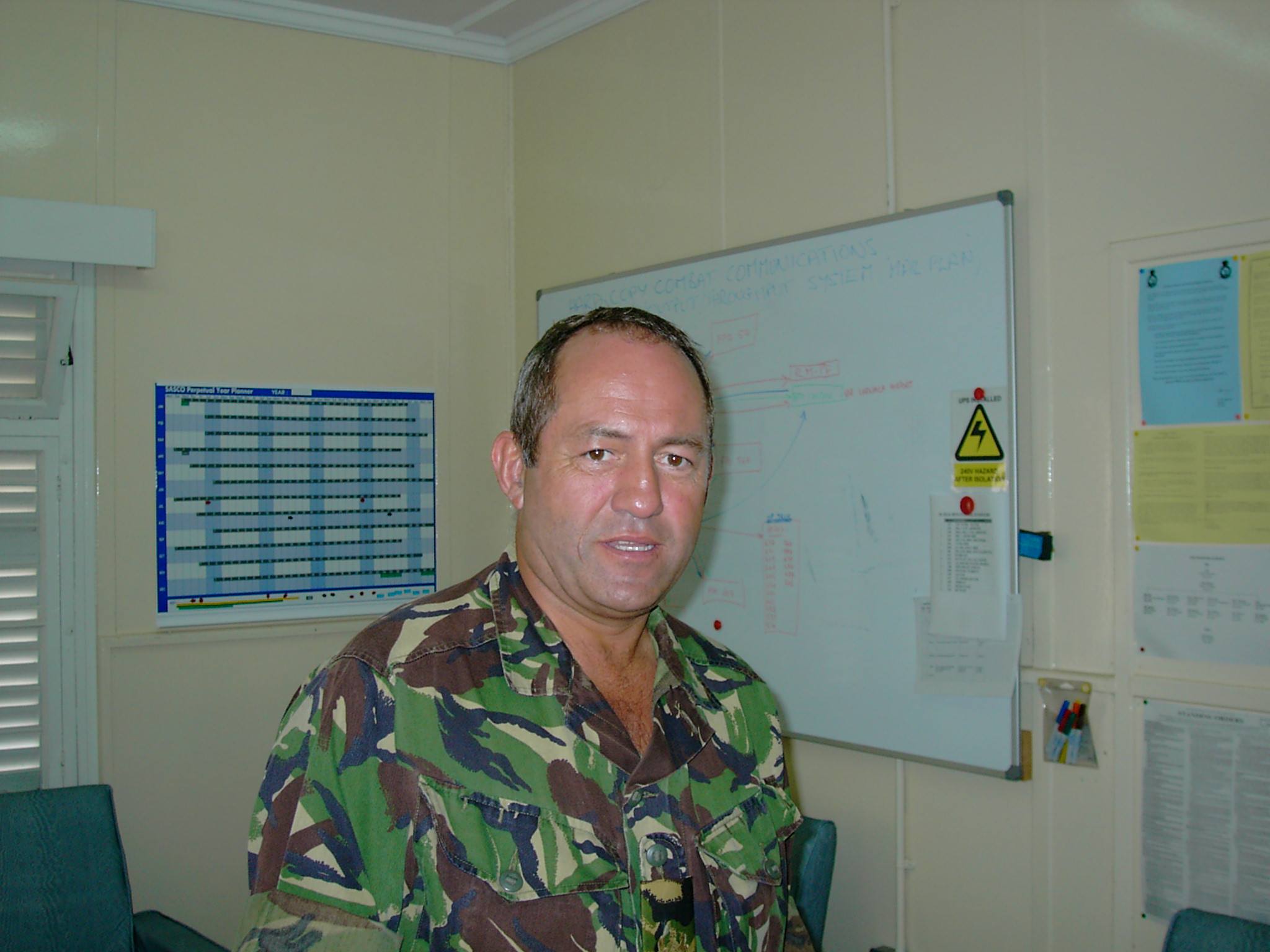
Col Doug Swanson
 Every paratrooper can tell you tale of his exploits on exiting an aircraft. But how many walk off the drop zone thanks to their reserve chute being deployed by yanking the red handle?
Many more non paratroopers also have similar personal experiences, but they are parachutists – not paratroopers.! They have not been through “P” Company, one of the toughest and unforgettable lifetime experiences. A harsh reminder of the difficulty is that the other two officers who started pre para training at the same time as myself died during the course – one died on a run and the other drove home at the end of a day and died when parking his car in his garage. Nor do parachutists generally jump in groups ranging from 5 or 6 up to 64 using both aircraft exits – and often in the dark.
Back in 1992 whilst leading the Royal Mail sponsorship of the Olympic and Paralympic Teams for the games in Barcelona (no I did not go as my 2 weeks TA Training coincided with the games). Inverness for Barcelona, which, on reflection, I would not have exchanged. Anyway, I spent a weekend with the Paralympic Team at Keil University. At a meeting of the Blind Team, I was mighty impressed when the Chairman announced that he was going to make a parachute jump to raise money for his team. Looking at his face, his eyes were completely white, totally blind. In response to a question from the meeting, asking how he would know when he was about to hit the ground. Calmly he said, “That will be easy, as the lead on my guide dog will go slack just before the impact!” I have told this tale to many groups to howls of laughter. One of my granddaughter’s blind friends, who worked on the stage as a comedy act, told that tale at the start of his act forever after I told it in his company.
But then some of us are here today after having had to deploy their reserve. There is not a lot of time to achieve this, as jumping from 800 feet by day and 1200 by night, it does not take many seconds to hit the ground if one’s main chute fails to open. Accelerating at 120 feet per second per second means less than seven seconds from leaving the aircraft to hitting terra firma. But one does not think about this.
On leaving the aircraft it is “Check your canopy”. If this is okay, then it’s “All round observation” to make sure no one is in your air space and that you are not in theirs. Next, assess your drift and steer, pulling on the appropriate rigging lines to slow your drift driving into any wind to make your landing safer. Incidentally I once got this very wrong in the pitch-black night over Chalk Farm on Salisbury Plain. I felt the wind in my face so assumed I was being blown backwards and steered to drive into the wind. When I landed it was feet first followed by the front of my helmet and almost knocking myself out. I had been drifting forwards and accelerated this with my misjudged steering. You live and learn!
In the mandatory ground training with the RAF in the week before parachuting we always had a spell in the harnesses stepping off a platform and swinging as one would under a parachute. There was always a shout of “Chute not deployed” which meant we had to yank out our red handle to notionally deploy our reserves. In the training hanger the reserves did not open, and the red handles were tied to the parachute.
On our Parachute Training Course at RAF Abingdon, we spent four weeks learning how to parachute and how to ensure our own and others safety. One must admit the training was excellent, as were the accommodation and meals. During the training we would start with two jumps from a balloon cage from 800 feet on two different days. As the only regular officer on the course, it was my “honour” to be first at doing everything that was new.
The first four aircraft drops were made clean fatigue which meant we did not carry any equipment. The first one was on 11 November 1965, and this was now real. First out the door and looking up saw I had a blown periphery which meant one or more rigging lines were over the canopy giving me less support that needed. But hang on a second the guilty rigging line was moving, and it slid off the canopy giving me a full chute. On landing the DZ Safety Officer asked what had happened. When I explained he said I had done the right thing although I could have opened my reserve, but by actions were fine.
In September 1967 I was lucky enough to be selected to complete an exchange with the French Para by spending two weeks at their Parachute School near Pau in the Pyrenees. We went in pairs for this, and my partner was a coloured Gunner officer who spoke English with a posh Oxford accent and French with a Parisian accent. With travel and admin this meant eight days when we could parachute. Week one we joined what is their equivalent of Sandhurst students and we learned how to operate all their airborne kit (and that their normal training parachuting height was 1200 feet) we joined them on an evening exercise parachuting onto scrubland to set demolition charges on a railway bridge. As an “Officier du genie” it was my “honour” to inspect the demolition charges and their positions on the bridge (glad of my physics and mechanics A Levels). The second week was with a group from the Légion étrangère française. Men from all over the world – and pretty hard too.
This week we would do many different things including pulling the red handle to open our reserves. This was serious, as not doing the correct  things one could break one’s nose or even collapse both parachutes. Attention paid!! Routine for the practice was checking our main chutes were open and then left hand over the reserve and keep it there, and with right hand pull the red handle and place it in the leg pocket of our trousers. Blast and double blast! British jungle greens only have a pocket on the left leg whereas the French have one on each leg! So, holding the reserve without letting it open and changing hands with the red handle and pocketing it. Then, legs tight together and chuck the reserve out in front of me and shake its rigging lines to get it open and prepare to land. Apparently if you let the reserve pass between your legs and deploy behind you, you land horizontal and are guaranteed a broken nose!!
We did two other interesting things in this week first was to parachute after a Jeep and try to land near it. For this the rear end of the Nord Atlas aircraft was removed and rollers fitted to the floor for the Jeep on its platform to roll out the back and would be followed by us. What I did not know, nor realise, is that when you chuck something as heavy as a Jeep out of an aircraft it suddenly rises in the air. I nearly fell to the floor but recovered in time to run out the back, stepping between the rollers. Following the French Major who had told us just to make a normal exit by running out the back of the plane. As an expert he did a freefall style exit spreadeagled in the slipstream. Me being heavier and more compact in my usual exit shape I passed under him and threw him off his usual route to land beside the landed Jeep. Once I landed (beside the Jeep) the Major arrived shouting “Vous cochon, vous cochon”  which, even with my O Level French, I realised was not a compliment!!
The next bit of excitement was to make a jump into water on 14 September. The “water” being the Lake at Lourdes where those of the Catholic Religion go on a pilgrimage to be immersed. So, my companion and self were out the door of the aircraft and clear sight all round and only the two of us in the air. I spot our recovery boat and start to steer to land near it. Looking at my pal I realised he was not going to land in the lake, so I shouted at him to steer for the water. He did not and landed on a concrete path at the lake edge. I landed in the water, went under, came up with my hand above my head (to prevent the parachute from sticking to my face) and remembering NOT to inflate my life jacket as I “did NOT have fear”. The safety boat collected me quickly and I observed my exchange partner standing on the lake edge shouting in his perfect French for the team to collect him. The group of Legionnaires on the boat shouted something in unison, which roughly told him to walk back round the Lake and not to forget his parachutes and lifejacket!
And so ended our short stay with Les Paras, who were immensely hospitable and kind to their two Brits. Wonderful food and mighty fine Mess life with free wines with meals and terrific company. French Paratrooper brevets and home to Blighty after 12 excellent days with our French Comrades. Managed 14 jumps in 8 days and awarded French wings and made Honorary members of 2 RAP – Second Airoporte Regiment.
Two more tales about operating reserve parachutes. On my final night drop in the Brigade, we were bound for Everleigh DZ on the Salisbury Plain for a night descent in the dark from an Argosy aircraft. Over the DZ and second out the port exit looked up and saw my parachute looking  like a bundle of washing. A real blown periphery, so pulled the red handle and threw it over my shoulder and my reserve fully deploys immediately. Just then a voice calls “steer away, steer away” and a body passes through my rigging lines from behind. It is followed by his parachute. (What he should have done was to spreadeagle and bounce off my rigging lines. But too late for that.). I realised that we were safe with my one and a bit chutes up and open, and not wishing for my new friends chute to open under me and collapse my chute, I grabbed hold of his chute as it tried to slip from behind my shoulder. I shout to him how we were and to lower his container and confirm he had. (The containers held our kit and rifle all weighing between 60 and 80 pounds and when lowered was held by a 20 feet long rope attached to our parachute harness)
I then told him to watch his head as I was about to lower my container. This done we glided to earth, and then he hit the ground, my container hit the ground, my parachutes breathed, and I landed gently. I find that my interloper was in some pain as he had forgotten to pull the leg release on his container. So, when it was released, it slid down his leg and stayed there for his landing and damaged his ankle – no one has ever managed to lift their container when it had slid down to their ankle. The DZ medics were quick to arrive and the Military Police Sergeant (my new pal) on the stretcher in the ambulance was joined by we six posties, driven off the DZ, and united with our transport and taken to the nearby pub where our tradition demanded a beer or two after another safe night parachuting.
And finally, the real need for the red handle safety of my reserve. Parachuting onto Hankley Common in April 1968 with 5 of the unit including Sergeant Dave Gladwin. One of the few Seniors who graced the unit and left as highly experienced paratroopers. Out the door over the DZ and almost casually look up to see my parachute fully deployed. But no!! There was a knot under the main canopy, and it prevented the chute from opening. Just enough time to shout “F*cking H*ll” before pulling my red handle (and throwing it over my shoulder, as trained) causing my reserve to open fully in an instant. Brakes on at 300 feet and just enough time to flick the quick release hooks and drop my container on its rope attached to my harness and on I go to a soft landing as my opening reserve had knocked the knot off my main chute. What I did not know at the time was thar Sgt Gladwin had seen me hurtling towards the ground and shouted “Goodbye, Sir”. But justice was delivered in another form. Dave had loaded his container, not with military kit, but neatly folded mail bags which gave bulk without the weight of kit. Unfortunately, when he landed, his container had come to earth in one of the many puddles on Hankley DZ. Now his container was full of soaked mailbags, which I believe were heavier than the kit normally carried. Anyway, good reason for Unit laughter and a comradeship celebration. Oh, and I went to Hankley Common DZ the following weekend and found what I have always believed to be the red handle that saved me from not being here by less than 3 seconds!!
1967 proved a terrific year for the Unit. We had taken ourselves from being known as The Postal Balloon Unit to being the Unit with the very best parachuting record in the Brigade for the year with 250 aircraft jumps between the 12 of us and 87 of those by night – AND not a single injury. Proud or what?? Everyone now knew the 16 Parachute Brigade PCCU RE; often chalk commanders with 50 Para Regiment members on board – and behind us in the queue to exit over the DZ.
(I think somebody did not much like parachuting from aircraft and so the unit then only parachuted from balloon cages!)


 So, we settled into a routine of military fitness and parachute training as well running our Field Post Office (FPO) and supporting overseas exercises and operations, mostly with one or two away on trade or education courses. Exercises and operations were mostly for two or three personnel, although we did all manage a 3-week exercise in Germany in 1967 on which we did much postal work and a fair bit of soldiering. We also took part in several Brigade exercises in the UK. We did organise a good task in the summers when we ran the FPO at Earl’s Court for the Royal Tournament and each December we decamped all those not needed in Aldershot to Mil Hill to help with the Christmas post. Hard work – but also a ton of fun!
 I did several memorable things in the Paras – like having lunch with The Queen (twice) and doing an exchange au pair with the French Paras when we did one week parachuting and training with Les Paras and the second week with the Les Étrangers (The Foreign Legion), including a drop into the Lake at Lourdes. Bless me! Best of all were the men in the unit and the camaraderie of being a member of Britain’s Parachute Brigade.
 finally decided in the interest of administrative efficiency and the maintenance of morale that elements of the unit should accompany the assault forces prior to ‘H’ Hour.